
To stop cats killing birds, use a layered approach: keep your cat indoors during dawn and dusk, fit them with a BirdsBeSafe collar cover or CatBib, add 5 minutes of daily interactive play, and switch to a high-protein diet. Research shows these steps reduce hunting by up to 36%. For feral cats, use garden deterrents and contact a local Trap-Neuter-Return (TNR) program.
You wake up, open the back door, and there it is — another “Bird Body Gift” on the doorstep. Your sweet house cat sits nearby, looking quietly pleased with herself.
“The line between feral predator and sweet house cat is thin here, y’all” — a sentiment shared by cat owners everywhere who love their pets but dread what they find each morning.
Free-ranging domestic cats kill an estimated 1.3 to 4.0 billion birds in the United States every year, making them the single largest human-linked cause of bird death in North America (Nature Communications, 2013). The birds outside your window right now are vulnerable to cat predation — and the generic advice you’ve already read (“just keep them indoors”) doesn’t account for your cat’s wellbeing or the strays you can’t control.
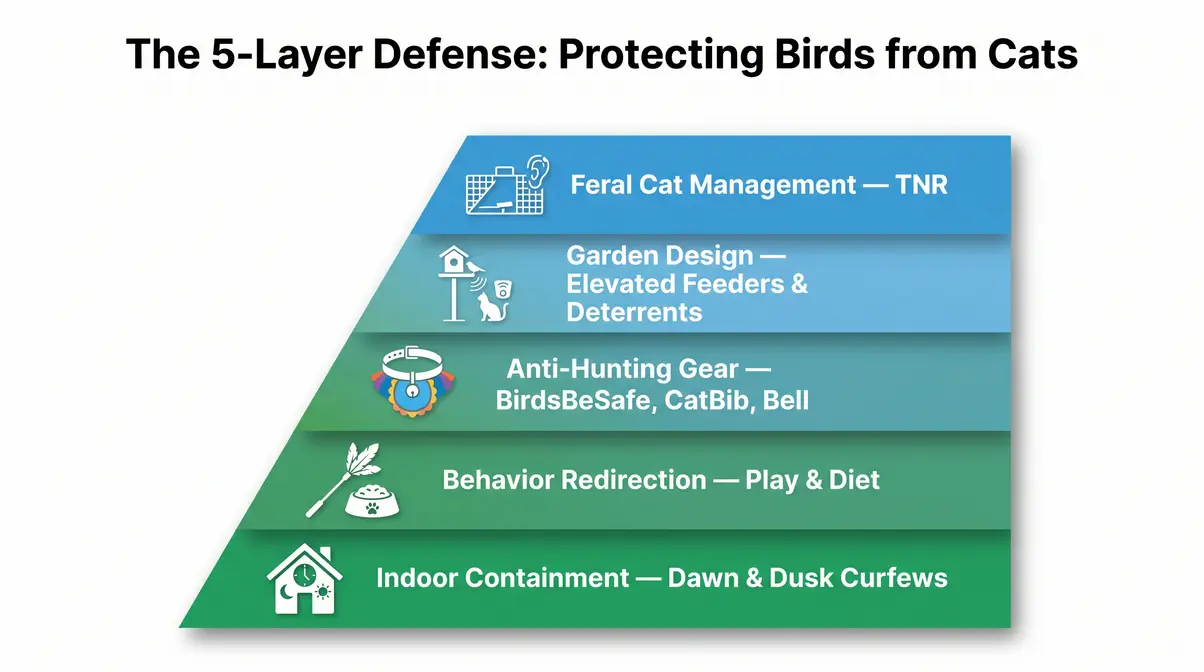
This guide gives you a 5-step, science-backed plan to stop cats killing birds — without making your cat miserable. You’ll work through The 5-Layer Defense: indoor containment, behavior redirection, protective gear, garden design, and feral cat management. Start at the base layer and add layers until the hunting stops. The infographic below shows all five layers at a glance.
If you want to know how to stop cats killing birds, start here: Cats kill an estimated 1.3–4.0 billion birds per year in the US, but a layered approach using The 5-Layer Defense can dramatically reduce your cat’s hunting.
- Keep cats indoors or restrict outdoor access during dawn and dusk (peak hunting hours)
- 5 minutes of daily play reduces hunting by 25% (Current Biology, 2021)
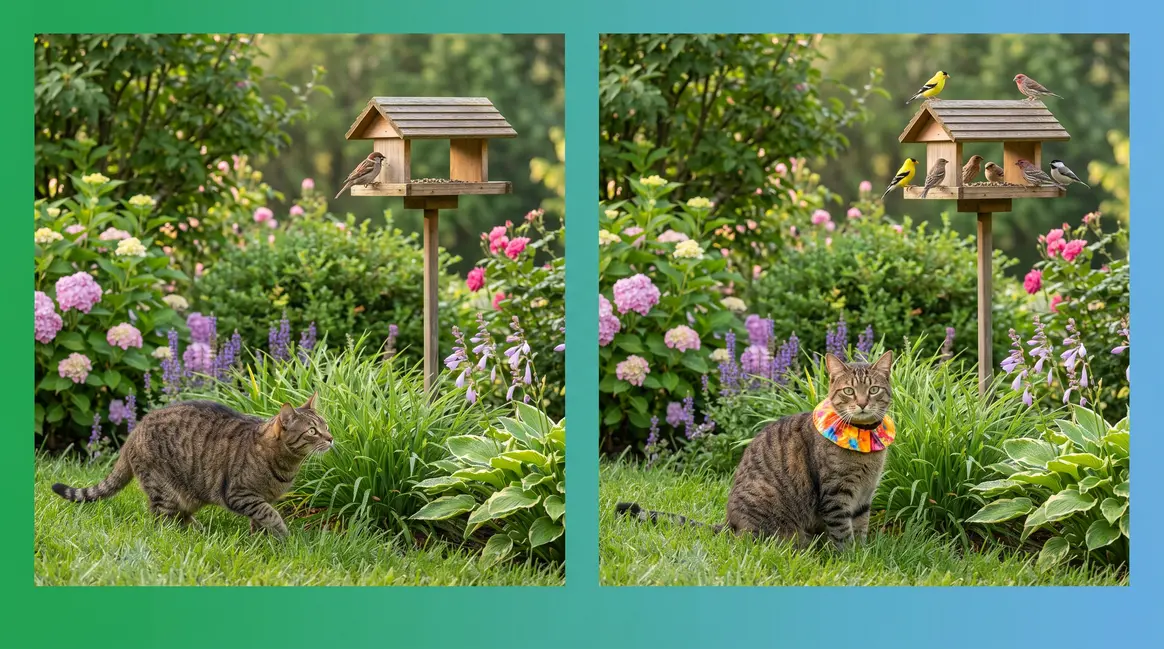
- BirdsBeSafe collar covers reduce bird catches by 87% for outdoor cats
- Garden changes — elevated feeders and citrus deterrents — protect birds from strays too
- The 5-Layer Defense: Start at the base layer (containment) and add layers until the hunting stops
Before You Start: Understanding Why Your Cat Hunts
- Estimated Time: 2 to 4 weeks for full transition and habit building.
- What You’ll Need:
- Wand toys with feather attachments
- High-protein, grain-free cat food
- BirdsBeSafe collar cover or CatBib
- Quick-release (breakaway) collar
- Citrus peels or natural garden deterrents
Cats hunt because millions of years of evolution told them to — full stop. Understanding that reality makes every step in this guide make sense, and it keeps you from blaming yourself (or your cat). For deeper insights into understanding why cats hunt birds, it helps to look at their evolutionary wiring.
Why Your Cat Hunts Even When Full
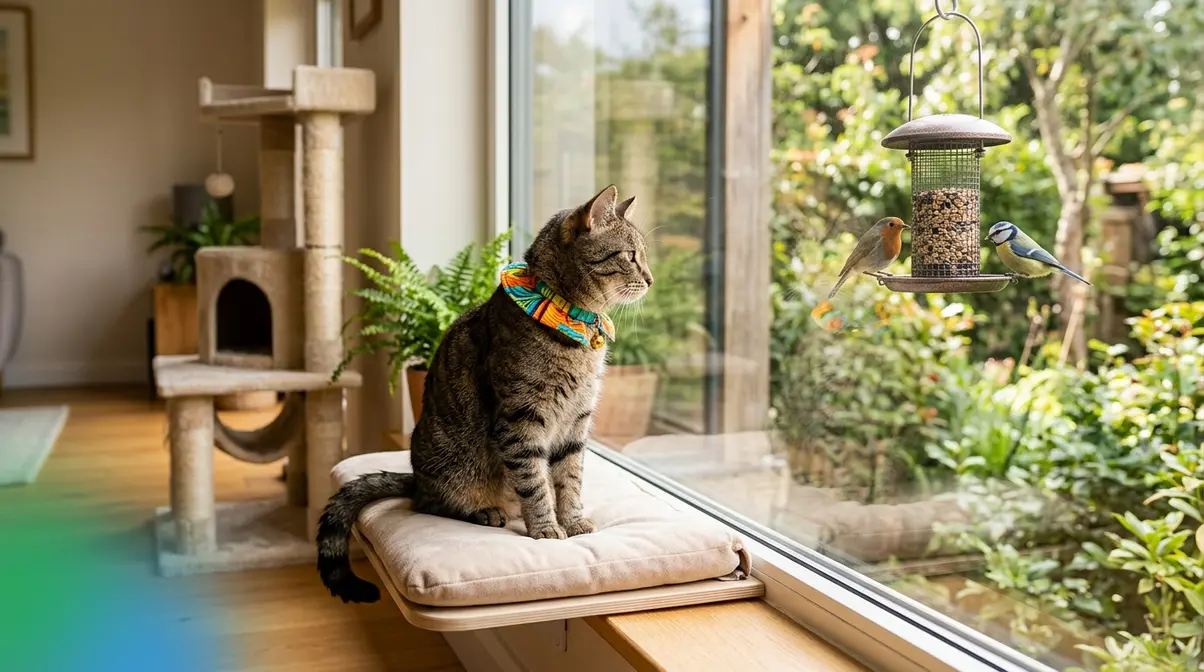
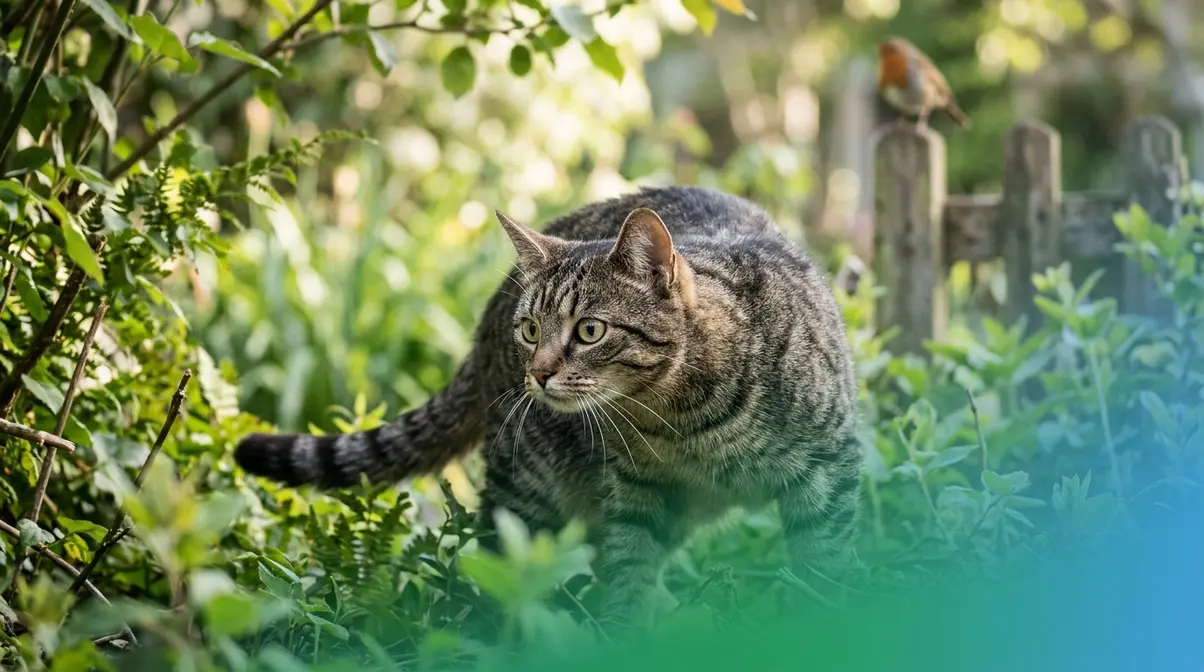
Your cat’s hunting drive is completely separate from hunger. These are two distinct neurological systems. Hunger is controlled by metabolic signals; hunting is triggered by movement, sound, and the thrill of the stalk. A cat that has just finished a full bowl of food will still bolt across the yard to chase a sparrow — because the sight of a moving bird activates a hardwired predatory sequence: orient → stalk → pounce → catch → kill.
This is why the question “Why has my cat suddenly started killing birds?” often comes up in spring and early summer. Fledgling birds — young birds that have just left the nest — are slower, louder, and more ground-level than adults. They are significantly more vulnerable to cat predation during this window, which typically runs from May through July. Your cat hasn’t changed; the bird population temporarily became easier prey.
Research from the University of Exeter published in Current Biology (2021) confirmed something important: even well-fed, enriched cats retain strong hunting instincts. The good news from that same study is that targeted interventions — specifically diet and play — can reduce hunting by up to 36%, which we cover in Step 2.
The Real Scale of Cat Predation on Birds
The numbers are striking. A landmark study in Nature Communications (2013) estimated that free-ranging cats — both owned pets and unowned ferals — kill between 1.3 and 4.0 billion birds annually in the US alone. Unowned feral cats cause the majority of that mortality, but owned outdoor cats still contribute meaningfully.
What makes this harder to track is that owners rarely see the full picture. A study by the University of Georgia using “Kitty Cams” — small cameras attached to pet cats’ collars — found that roughly 30% of outdoor cats actively hunt, but owners only ever witnessed about 23% of the prey their cats actually caught. In other words, your cat is probably killing more birds than you realize, because most prey is consumed, cached, or abandoned away from the house.
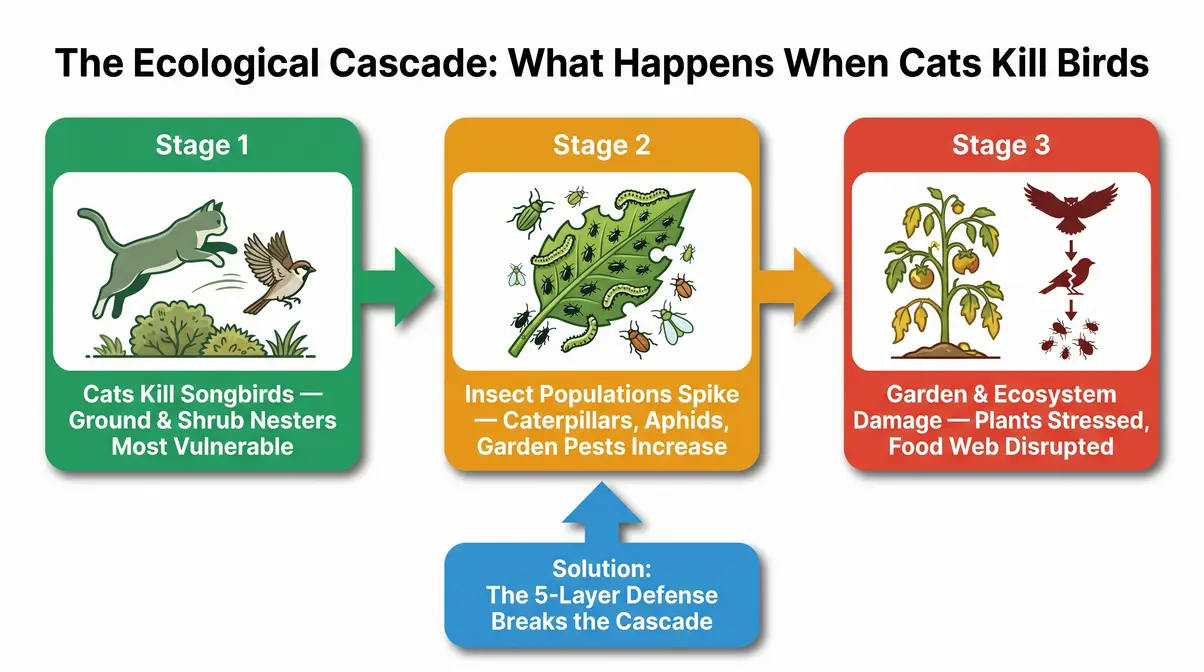
Beyond individual bird deaths, cat predation creates an ecological cascade effect. When ground-nesting and shrub-nesting songbird populations decline in a neighborhood, insect populations that those birds control can spike — affecting local gardens, trees, and the food web more broadly. This is why learning how to stop cats from killing birds matters beyond your own backyard.
Step 1: Keep Your Cat Indoors

The single most effective way to prevent cat predation is to keep your cat inside. Studies consistently show that indoor-only cats kill zero birds. But “just keep them indoors” is easier said than done — especially if your cat has been an outdoor cat for years. While there are many reasons cats catch birds, limiting their access to the outdoors is the most foolproof solution. The good news is that there are practical ways to manage the transition, and smart outdoor alternatives that satisfy your cat’s curiosity without giving birds a death sentence.
Making the Indoor Transition Easier for Your Cat
A cold-turkey indoor switch often fails because cats become frustrated, destructive, and vocal. A gradual transition works far better.
Steps to transition an outdoor cat indoors:
- Start with curfews, not lockdowns. Keep your cat inside during the two highest-risk windows: dawn (30 minutes before and after sunrise) and dusk (30 minutes before and after sunset). Most bird hunting happens during these low-light periods when birds are most active and cats hunt most effectively.
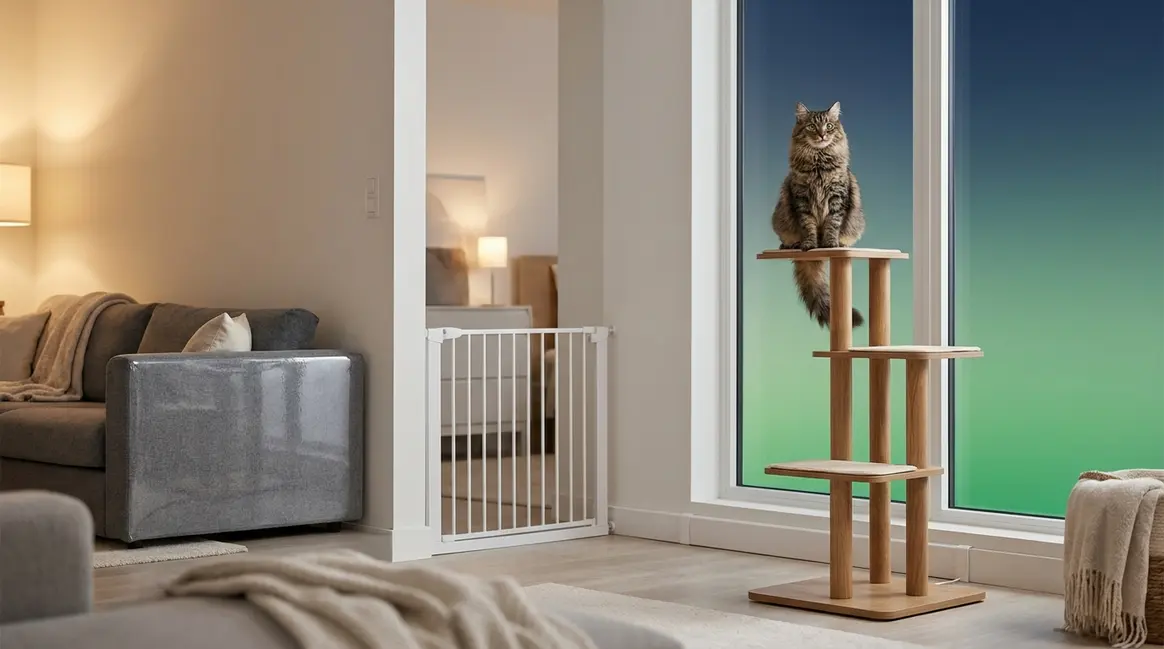
- Add environmental enrichment immediately. Window perches, bird feeders placed just outside the glass (so your cat can watch without hunting), puzzle feeders, and climbing trees keep an indoor cat mentally stimulated.
- Extend indoor time gradually. After two weeks of curfew-only, try keeping your cat in for full days on weekends. Most cats adapt within four to six weeks.
- Never punish outdoor attempts. Redirect with a toy or treat — punishment creates anxiety, which can worsen hunting behavior.
Cat owners in online communities consistently report that the curfew-first approach dramatically reduces resistance compared to a sudden full-time indoor switch.
Safe Outdoor Alternatives: Catios and Supervised Time
A catio — an enclosed outdoor space for cats, typically built from wood framing and wire mesh — gives your cat fresh air, sunlight, and sensory stimulation without allowing them to roam and hunt. Catios range from a simple window box to a full garden enclosure. The National Wildlife Federation recommends enclosed outdoor spaces as one of the most effective long-term solutions for outdoor-loving cats.
Leash training is another option that surprises many cat owners. With a properly fitted harness (never attach a leash to a collar), cats can enjoy supervised outdoor exploration. It takes patience — plan for two to four weeks of harness desensitization before outdoor walks — but many cats adapt well.
Checkpoint: Your cat is spending at least the dawn and dusk hours indoors. Bird activity in your garden has increased or stabilized. If you’ve built a catio, your cat is using it willingly.
Step 2: Redirect Hunting Instincts with Play and Diet
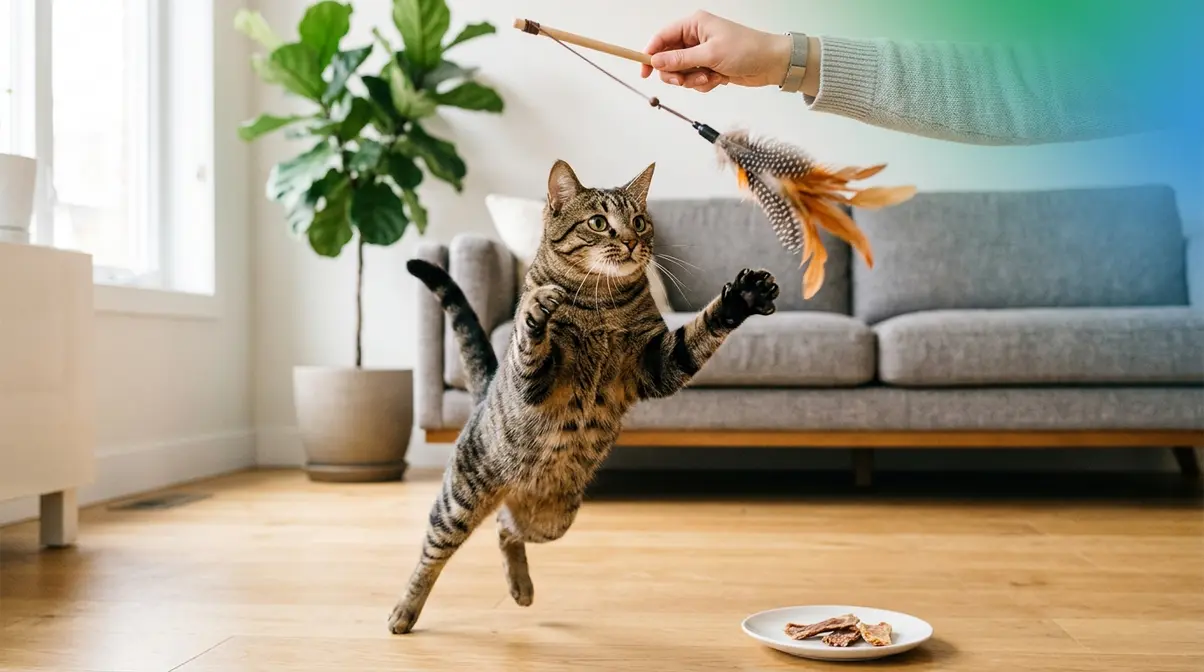
If full indoor containment isn’t possible, the next layer of The 5-Layer Defense targets the root cause: an unmet predatory drive. If you are wondering how to stop cats killing birds without keeping them inside 24/7, redirecting their instincts is the next best step. Research from the University of Exeter shows that two specific interventions — structured play and dietary change — can reduce the number of animals your cat brings home by up to 36% (Current Biology, 2021). This is the most underreported finding in the entire cat predation space, and no comparable competitor content cites it directly. You can easily combine this with other indoor enrichment activities for cats to keep them fully stimulated.
The 5-Minute Play Technique That Reduces Hunting by 25%
The University of Exeter study found that just five minutes of interactive play per day — using a wand toy that mimics bird or mouse movement — reduced the number of prey animals cats brought home by 25% (Current Biology, 2021). The mechanism is straightforward: interactive play allows your cat to complete the full predatory sequence (stalk → chase → catch → “kill”) in a controlled way. Once that drive is discharged, the urgency to hunt real prey decreases.
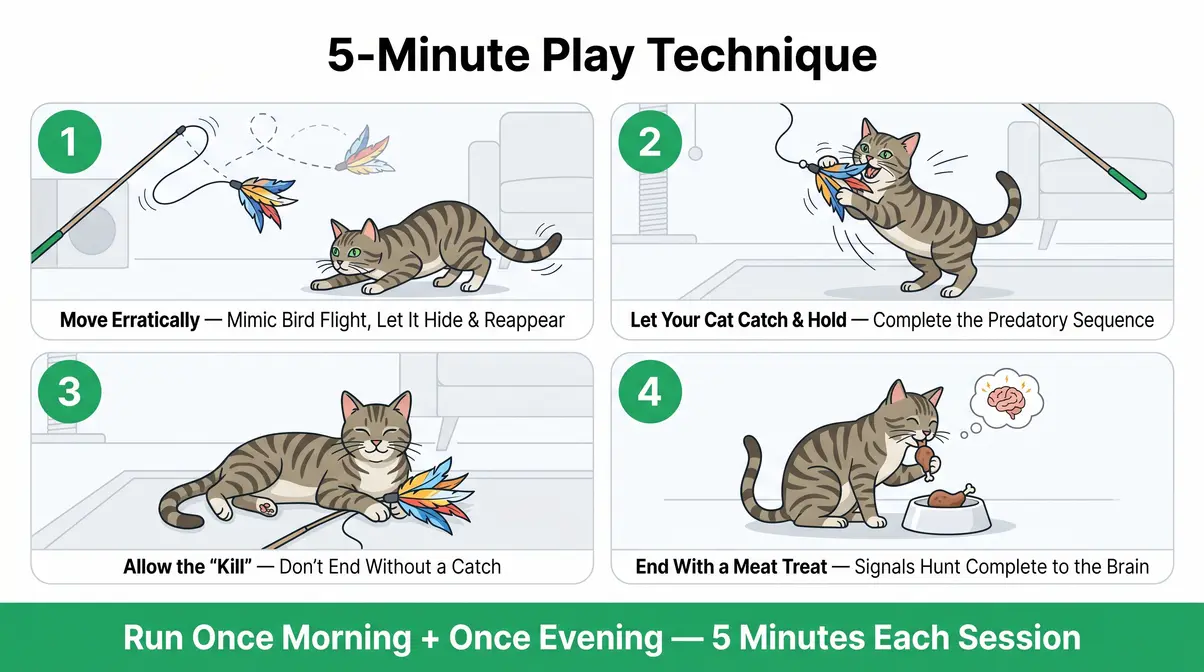
How to run the 5-minute play session:
- Use a wand toy with feathers or a realistic bird silhouette — movement that mimics a bird in flight is most effective.
- Move the toy erratically, not in straight lines. Let it “hide” behind furniture and reappear suddenly.
- Allow your cat to catch and hold the toy several times per session. Ending the session without a “catch” leaves the predatory cycle incomplete and can increase frustration.
- End every session with a small meat-based treat — this mimics the “eating after a kill” phase and signals to your cat’s brain that the hunt is complete.
- Run the session once in the morning and once in the evening — the two peak hunting periods.
Switch to a High-Protein Diet to Curb the Hunt
The same University of Exeter Current Biology (2021) study found that switching cats to a grain-free, high-meat-protein diet reduced prey brought home by 36% — the largest single-intervention reduction measured in the study. The researchers believe the mechanism involves nutritional completeness: cats fed grain-heavy or plant-protein-heavy foods may hunt to compensate for amino acid deficiencies that their instincts associate with animal prey.
How to make the dietary switch safely:
- Check your current cat food’s ingredient list. If the first three ingredients include corn, wheat, rice, or “poultry by-product meal,” a switch is worth trying.
- Look for foods where a named meat (chicken, turkey, salmon) is the first ingredient, with protein content above 40% on a dry matter basis.
- Transition gradually over seven to ten days — mix 25% new food with 75% old food for the first three days, then 50/50 for three days, then 75% new for the final three days. Abrupt switches can cause digestive upset.
- Consult your veterinarian before switching, particularly if your cat has kidney disease or urinary issues, as high-protein diets require adequate hydration.
The Cornell Feline Health Center recommends discussing any significant dietary change with a veterinarian, particularly for senior cats.
Checkpoint: After four weeks of daily play and dietary transition, track how many “gifts” your cat brings home per week. Most owners report a noticeable drop within three weeks.
Step 3: Fit Your Cat with Anti-Hunting Gear
The third layer of The 5-Layer Defense adds a physical intervention: specialized gear that either warns birds of your cat’s approach or physically prevents a successful pounce. These products are designed for cats that will continue to spend time outdoors.
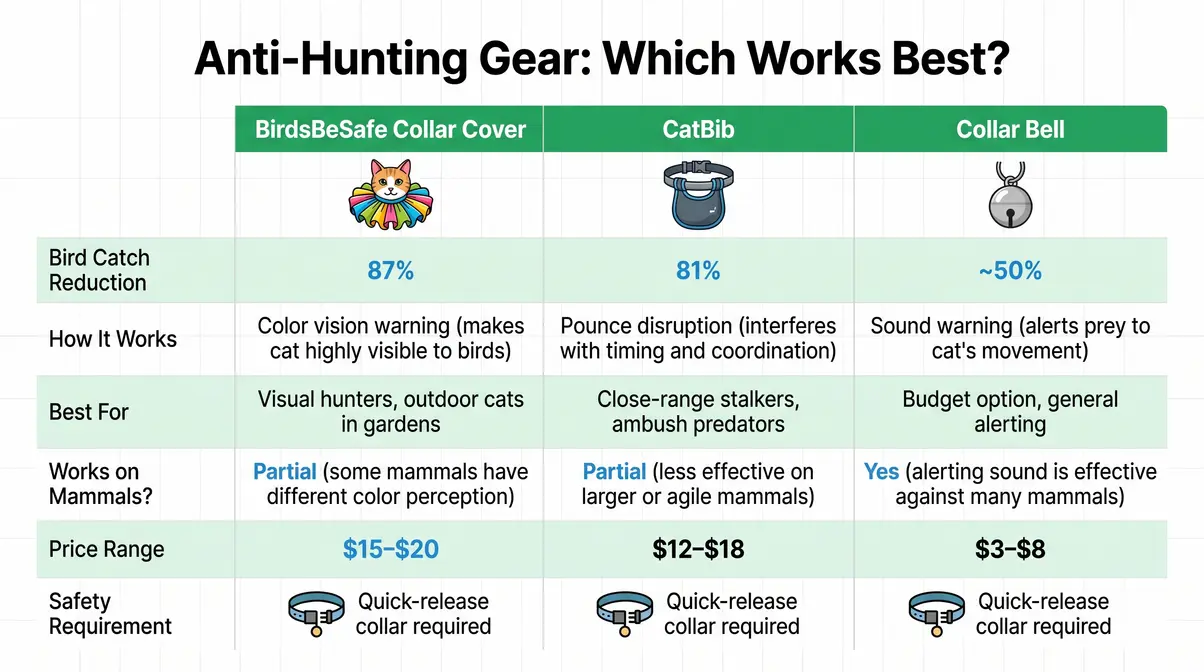
BirdsBeSafe Collar Covers: 87% Fewer Bird Catches
The BirdsBeSafe collar cover is a brightly colored fabric ruff that fits around your cat’s existing quick-release collar. Birds have tetrachromatic vision — they see ultraviolet light and are highly sensitive to bright colors — which means they spot the collar cover from a distance and fly away before a cat can get close enough to strike.
A peer-reviewed study published in Global Ecology and Conservation (2015) found that BirdsBeSafe collar covers reduced bird catches by 87% compared to cats without the cover. The effect on mammals (mice, voles) was much smaller — around 47% — because mammals rely more on hearing than vision. For protecting birds specifically, this is one of the most effective single products available.
The collar cover attaches to any standard quick-release (breakaway) collar — never a regular buckle collar, which can snag on branches and trap your cat. BirdsBeSafe sells their own compatible collar, or you can attach the cover to a collar you already own. Visit CatGoods for product options and sizing guides.
The CatBib: Physical Prevention That Doesn’t Rely on Sound
The CatBib is a small, brightly colored neoprene bib that hangs from your cat’s collar and rests against their chest. When a cat lunges forward to catch a bird, the bib swings outward and interrupts the precise timing of the pounce — the cat can still move freely, but can’t execute the final high-speed strike with accuracy.
A study cited by the manufacturer found the CatBib reduced bird catches by approximately 81% without significantly affecting normal cat movement, playing, climbing, or grooming. Unlike the BirdsBeSafe collar cover, the CatBib works at close range — even after a cat has stalked to striking distance. The two products can be used together for maximum protection.
The CatBib comes in small, medium, and large sizes. Fit is important: too large and it will annoy your cat into removing it; too small and it won’t interrupt the pounce effectively. Available at CatGoods.
Collar Bells: Simple, Low-Cost, and Partially Effective
A small bell attached to a quick-release collar is the oldest and most widely used bird-protection method. Research suggests bells reduce bird catches by approximately 50% — meaningful, but lower than either the BirdsBeSafe cover or the CatBib (Songbird Survival, UK). The limitation is that experienced hunters learn to move slowly enough that the bell barely rings, and birds don’t always respond to sound the way they respond to visual warnings.
Safety note: Always use a quick-release (breakaway) collar — never a standard buckle collar. A regular collar can catch on a branch or fence, trapping your cat. Quick-release collars are designed to snap open under pressure. This applies to every collar-mounted product in this section.
A brief note on cone alternatives: If your cat has recently had surgery and you’re looking for a cone alternative while they recover, a soft fabric collar (like an inflatable donut collar) serves the purpose without the BirdsBeSafe or CatBib function — these are separate products for different needs.
Checkpoint: Your cat is wearing a properly fitted quick-release collar with at least one anti-hunting accessory. Check the collar fit weekly — you should be able to slide two fingers underneath.
Step 4: Make Your Garden Bird-Safe
Even if your own cat is wearing a BirdsBeSafe cover and coming in at dusk, your garden may still be attracting hunting from neighboring cats or strays. The fourth layer of The 5-Layer Defense focuses on making your outdoor space structurally harder for any cat to hunt in, which is crucial for making your garden a no-hunt zone. Learning how to stop cats killing birds also requires looking at your yard’s layout.
How to Position Bird Feeders Out of a Cat’s Reach
Bird feeders placed at ground level or on low posts are hunting stations for cats. A cat can crouch beneath a feeder and ambush birds as they land and feed — a simple change in feeder placement can eliminate this entirely.
Feeder placement rules:
- Mount feeders on smooth metal poles at least 5 feet tall — cats cannot grip smooth metal surfaces.
- Add a baffle (a cone-shaped guard) at least 18 inches below the feeder — this prevents cats from climbing the pole.
- Position feeders at least 10 feet from any tree, fence, or structure that a cat could use as a launch point.
- Clear away dense ground cover within a 5-foot radius of the feeder base — this removes the hiding spots cats use to stalk feeding birds.
The Audubon Society recommends elevated placement as one of the most immediately effective garden changes for protecting feeding birds.
What Smell Do Feral Cats Hate? Natural Deterrents
Cats have a highly sensitive sense of smell and actively avoid certain scents. If you are wondering, what smell do feral cats hate? Citrus is the most reliably effective natural cat deterrent. Cats have approximately 200 million scent receptors (compared to 5 million in humans), making them highly sensitive to strong odors. The most effective natural deterrents include:
- Citrus peel (lemon, orange, grapefruit) — scatter fresh peels around garden borders and bird feeding areas. Replace every two to three days as the scent fades.
- Rue (Ruta graveolens) — a hardy perennial plant that cats find strongly repellent. Plant it around garden borders and near feeder bases.
- Coleus canina (the “Scaredy Cat plant”) — specifically bred as a cat deterrent; the smell is undetectable to humans but highly aversive to cats.
- Commercial citrus-based sprays — applied to fence tops, garden borders, and areas where cats have been seen crouching.
Avoid using mothballs or toxic substances — these harm cats, birds, and other wildlife, and are illegal to use as animal deterrents in many US states.
Checkpoint: Bird feeders are elevated and baffled. Citrus peels or deterrent plants are in place around garden borders. Check for fresh cat tracks or disturbed soil weekly.
Step 5: Address Feral and Neighbor Cats
The fifth and final layer of The 5-Layer Defense targets the cats you don’t own. Feral and neighbor cats are responsible for a disproportionate share of bird mortality — the Nature Communications (2013) study estimated that unowned cats cause roughly 69% of all cat-related bird deaths in the US. You can’t put a BirdsBeSafe collar on a stray, so different strategies apply.
Trap-Neuter-Return (TNR): The Community-Level Solution
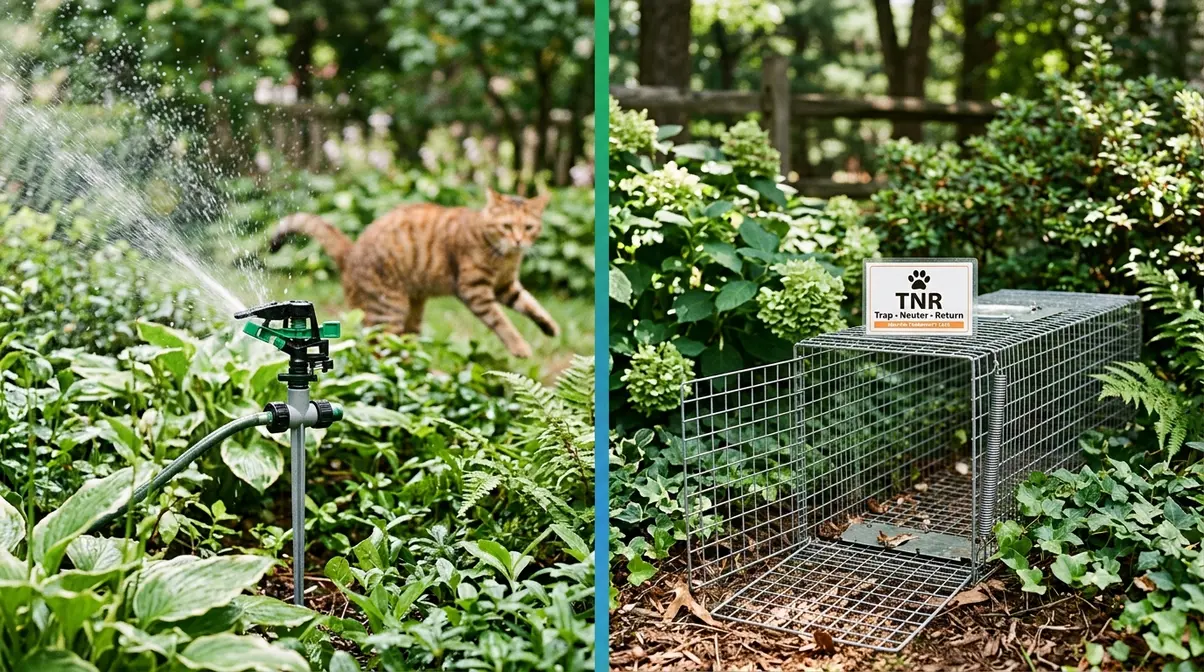
Trap-Neuter-Return (TNR) is a program where feral cats are humanely trapped, surgically sterilized by a veterinarian, vaccinated, and then returned to their outdoor territory. TNR does not eliminate feral cat colonies immediately, but it stabilizes population size over time — sterilized cats defend territory that would otherwise be colonized by new, reproducing cats.
From a bird protection standpoint, TNR colonies managed by dedicated caretakers tend to be more stable and smaller than unmanaged feral populations. TNR is endorsed by the USDA APHIS as the most humane and practically effective approach to managing outdoor feral cat populations in urban and suburban environments.
How to access TNR in your area:
- Contact your local animal shelter or humane society — most maintain lists of active TNR programs.
- Search the Alley Cat Allies national database (alleycat.org) for TNR resources in your zip code.
- If you have a feral colony on your property, contact a local TNR coordinator before attempting to trap cats yourself — improper trapping can injure cats and is illegal in some jurisdictions.
The Audubon Society acknowledges TNR as a community-level management tool, while also advocating for reducing outdoor cat populations overall.
Humane Deterrents to Keep Cats Off Your Property
For neighbor cats or strays you can’t enroll in TNR, physical deterrents can discourage territory use without harming the animals.
Feral cats are most active at dawn and dusk — the same windows that are highest-risk for bird hunting (USDA APHIS). Targeting deterrents at these times maximizes effectiveness.
Effective humane deterrents include:
- Motion-activated sprinklers — the sudden burst of water startles cats without harming them. Set the motion sensor to activate from dusk through mid-morning.
- Ultrasonic deterrent devices — emit a high-frequency sound when triggered by motion; inaudible to humans but uncomfortable for cats. Effectiveness varies by individual cat.
- Chicken wire or prickle strips on fence tops — cats prefer to walk on flat, stable surfaces; textured or unstable fence tops discourage this.
- Plastic carpet runner (spike-side up) placed on garden beds — cats dislike the texture underfoot and avoid treated areas.
Checkpoint: Feral or neighbor cat sightings in your garden have decreased. Motion-activated deterrents are triggering at dawn and dusk. If a feral colony is present, you’ve contacted a local TNR coordinator.
Verify Your Results
After implementing the layers of The 5-Layer Defense that apply to your situation, use these checkpoints to measure progress:
| Timeframe | What to Measure | Success Indicator |
|---|---|---|
| Week 1–2 | Bird “gifts” per week | Any reduction from baseline |
| Week 3–4 | Cat’s dawn/dusk location | Consistently indoors during peak hours |
| Week 4–6 | Play session compliance | Cat engages eagerly; hunting urgency visibly reduced |
| Week 6–8 | Garden bird activity | More birds visiting feeders; less flushing behavior |
| Month 3+ | Overall prey count | 25–36% reduction vs. pre-intervention baseline |
Track your starting baseline honestly: count every bird your cat brings home for one full week before making any changes. That number is your benchmark. Most cat owners who implement Steps 1 through 3 together report reaching the 25–36% reduction threshold within six to eight weeks.
Troubleshooting Common Issues
“My cat keeps removing the collar accessories.”
This is the most common failure point with BirdsBeSafe covers and CatBibs. First, check the fit — if the collar is loose, the cat can hook a paw under it. The collar should allow two fingers to slide underneath, no more. Second, try a different collar material: some cats tolerate neoprene better than fabric. Third, introduce the collar indoors for short sessions before leaving it on all day — desensitization reduces the urge to remove it.
“My cat goes crazy at night and hunts constantly.”
Cats are crepuscular (most active at dawn and dusk) but some cats, particularly younger ones, extend activity into full nighttime hours. If curfews aren’t working, consider keeping your cat fully indoor overnight. A comfortable, stimulating indoor environment — with a window perch, puzzle feeder, and access to fresh water — makes overnight containment much more tolerable for active cats.
“I’ve tried everything and my cat still hunts.”
Some cats have exceptionally high prey drive — particularly breeds like Bengals, Abyssinians, and domestic shorthairs with feral ancestry. For these cats, the honest answer is that full indoor living or a catio is the only reliably effective solution. The University of Exeter researchers noted that individual variation in prey drive is significant: some cats reduced hunting to near-zero with play and diet changes; others showed minimal response. If you’ve genuinely implemented all five layers and hunting continues, consult your veterinarian — in rare cases, anxiety-driven hunting responds to behavioral medication.
“I can’t afford a catio or specialty products right now.”
Start with the free interventions: curfews at dawn and dusk, five minutes of daily wand-toy play, and citrus peel deterrents in the garden. These cost nothing and together address three of the five defense layers. A standard collar bell (under $5) adds the fourth layer for minimal investment.
Frequently Asked Questions
What is the 3-3-3 rule for feral cats?
The 3-3-3 rule describes the adjustment timeline for a newly rehomed or newly trapped feral or semi-feral cat: 3 days to decompress and stop feeling overwhelmed, 3 weeks to learn routines and begin to feel safe, and 3 months to fully settle and show their true personality. For feral cats being managed outdoors through TNR, the rule is used by caretakers to assess whether a cat is truly feral (unlikely to tame within this window) or a lost/stray domestic cat that may be rehomeable. It helps caretakers make humane decisions about management versus adoption.
What device stops cats from killing birds?
Three devices have the strongest evidence behind them. The BirdsBeSafe collar cover — a bright fabric ruff — reduces bird catches by 87% by exploiting birds’ color vision (Global Ecology and Conservation, 2015). The CatBib, a neoprene bib that disrupts the final pounce, reduces bird catches by approximately 81%. Collar bells reduce catches by around 50% but are less effective against experienced hunters. All three require a quick-release (breakaway) collar for cat safety. For maximum protection, combine the BirdsBeSafe cover with a collar bell.
How many birds does a feral cat kill in a year?
Unowned feral cats kill an estimated 1.4 to 3.7 billion birds per year in the US — far more than owned pet cats (Nature Communications, 2013). On an individual basis, a single feral cat in a productive territory can kill hundreds of birds annually, though estimates vary widely by habitat and prey availability. The University of Georgia Kitty Cams study found that even owned outdoor cats that actively hunt average around 2 prey items per week during active seasons, with birds making up roughly 13% of total prey. Feral cats in the same habitats typically kill at significantly higher rates.
Why has my cat suddenly started killing birds?
The most common reason is seasonal prey availability. Spring and early summer bring an influx of fledgling birds — young birds just out of the nest that are slower, louder, and more ground-level than adults. They are far more vulnerable to cat predation, so even a cat that rarely hunted may suddenly bring home a bird every few days. Other triggers include a change in your cat’s outdoor range, a new outdoor access point, or reaching sexual maturity in an un-neutered cat (hunting behavior intensifies with hormonal activity). Neutering or spaying significantly reduces roaming and can lower hunting drive.
What time of day are feral cats most active?
Feral cats are most active at dawn and dusk. Because they are crepuscular animals, their natural hunting instincts peak during these low-light periods. This is when their specialized vision gives them the greatest advantage over prey. Keeping your own cats indoors during these specific windows, and setting up motion-activated deterrents in your garden during these hours, is the most effective way to minimize hunting.
How do I stop feral cats from killing birds on my property?
A combination of physical deterrents and community-level TNR is the most effective approach. For immediate protection, install motion-activated sprinklers set to trigger at dawn and dusk (peak feral cat activity), raise bird feeders to smooth metal poles at least 5 feet tall with baffles, and scatter citrus peels around garden borders. For longer-term population management, contact a local TNR (Trap-Neuter-Return) program through your local humane society or Alley Cat Allies. TNR stabilizes feral colony size over time, gradually reducing the number of hunting cats in your area without lethal control.
What can I use instead of a cone on my cat?
Soft inflatable donut collars and fabric recovery suits are the most popular cone alternatives. An inflatable donut collar (sometimes called an “E-collar alternative”) wraps around the neck like a travel pillow — it prevents your cat from reaching surgical sites or wounds without the rigid restriction of a plastic cone. Fabric recovery suits (like the Suitical Recovery Suit) cover the body entirely and are particularly useful for abdominal surgeries. Neither of these products prevents hunting — they are purely post-surgical recovery tools. If you need both post-surgical protection and hunting prevention, discuss options with your veterinarian before combining products.
Conclusion
For cat owners and bird lovers alike, the frustration of watching a sweet house cat become a feral predator in the garden is real — and so is the impact. Domestic and feral cats kill an estimated 1.3 to 4.0 billion birds in the US every year (Nature Communications, 2013), but that number is not fixed. Research from the University of Exeter shows that targeted, layered interventions can reduce individual cat hunting by up to 36% — and The 5-Layer Defense gives you a clear framework to build those layers systematically: indoor containment, behavior redirection, protective gear, garden design, and feral cat management.
The 5-Layer Defense works because it treats cat predation as a system problem, not a single-fix problem. No one intervention stops hunting completely — but combining curfews, five minutes of daily play, a high-protein diet, a BirdsBeSafe collar cover, and an elevated bird feeder creates overlapping protection that gives every bird in your garden a fighting chance. Figuring out how to stop cats killing birds doesn’t have to be an impossible battle.
Start this week with the two lowest-effort changes: implement dawn and dusk curfews, and begin the 5-minute daily play sessions. Track your baseline bird-gift count now, and check back in four weeks. Most cat owners see measurable improvement within a month — and that’s a result worth working toward.

Dave King
Cat owner and writer at Mad Cat Man.