
Table of Contents
- Step 1: Plaque vs. Tartar
- Step 2: Gather Your Supplies
- Step 3: The Low-Stress Intro
- Step 4: Proper Brushing Technique
- Step 5: Vet-Approved Alternatives
- Step 6: When Vet Care Is Required
- Step 7: Build a Lasting Routine
- Troubleshooting Common Problems
- Frequently Asked Questions
- When Home Care Isn’t Enough
- Building a Dental Routine That Actually Lasts
This blog post may contain affiliate links. As an Amazon Associate I earn from qualifying purchases.
This article is for informational purposes only and does not constitute veterinary advice. Always consult a licensed veterinarian before starting any new dental care routine for your cat, particularly if your cat shows signs of pain, red gums, difficulty eating, or significant tartar buildup.
Reviewed by a licensed veterinarian.
“My cat needs plaque removed but I can’t really afford it right now…” Sound familiar? You are not alone – this is one of the most common concerns shared across cat owner communities, and the good news is that you are not helpless.
Left untreated, plaque build-up leads to gingivitis, then periodontal disease, and eventually bacteria can enter the bloodstream and affect your cat’s kidneys, liver, and heart – turning a preventable dental issue into a far more expensive health crisis. The earlier you act, the more options you have.
This guide teaches you exactly how to remove plaque from cat teeth at home safely, which vet-approved alternatives work for cats that refuse brushing, and when professional care is the only safe path forward. We cover 7 practical steps, from understanding what plaque actually is to building a routine your cat will tolerate.
To remove plaque from cat teeth, brush daily using cat-safe enzymatic toothpaste and a finger brush or soft toothbrush, following a 3-5 day gradual introduction. For cats that refuse brushing, VOHC-approved dental treats, water additives, and dental gels are effective alternatives. This 7-step process shows visible results on soft plaque within 2-4 weeks of consistent daily care.
Removing plaque from cat teeth at home is possible with daily brushing using enzymatic toothpaste – plaque hardens into tartar within 24 hours of forming, making daily action essential (VCA Animal Hospitals, 2026).
- The Tiered Dental Defense: Match your method to your cat’s tolerance – passive VOHC-approved products first, active brushing second, professional vet cleaning last.
- Brushing is the gold standard: Enzymatic toothpaste disrupts plaque bacteria; human toothpaste contains fluoride and xylitol, both toxic to cats.
- Alternatives work: VOHC-approved treats, water additives, and dental gels reduce plaque in cats that refuse brushing.
- Tartar cannot be removed at home: Once plaque hardens into calculus, only a professional veterinary cleaning can safely remove it.
- 5 warning signs mean skip home care and call your vet today: bad breath, red gums, drooling, difficulty eating, and visible brown buildup.
What You’ll Need Before You Start
Gathering everything before your first session keeps you calm and prevents mid-session scrambling that stresses your cat. Here is what to have on hand:
- Cat-specific enzymatic toothpaste – poultry or malt flavour are most popular. Never use human toothpaste; it contains fluoride and xylitol, a compound that is toxic to cats and can cause liver failure. Available at most pet stores and vet clinics.
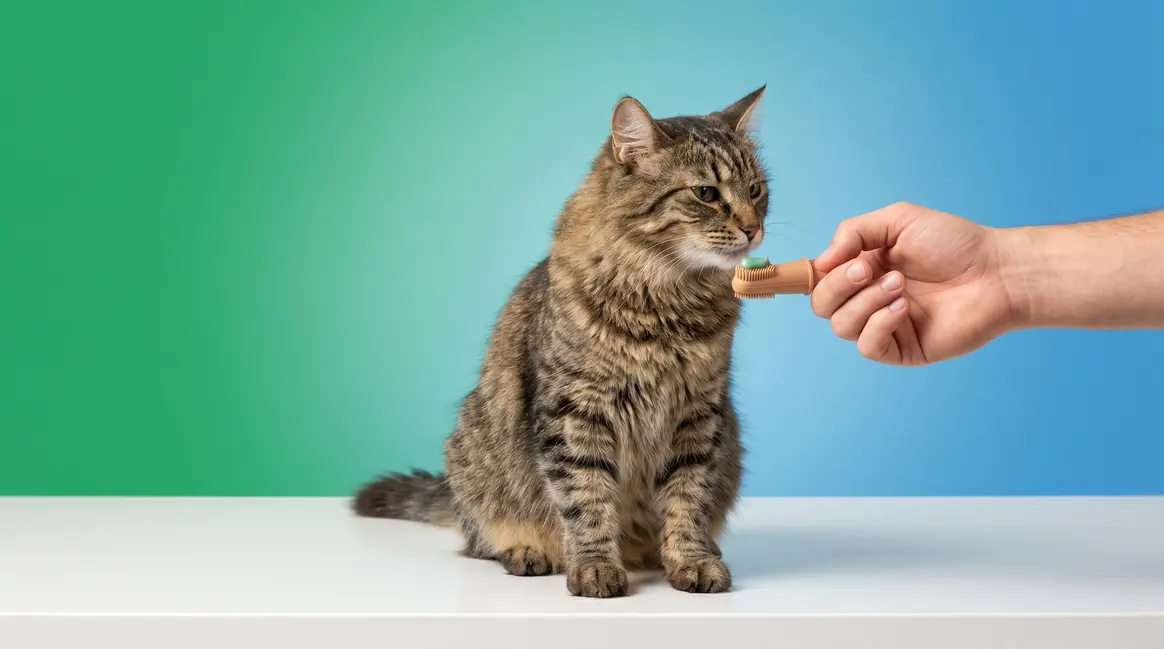
- Finger brush or soft-bristled cat toothbrush – a rubber finger brush fits over your fingertip and is gentler for beginners. A soft-bristled brush gives slightly better reach for back teeth. Both are sold at pet stores.
- Cotton buds / Q-tips – used only during the first 2-3 days of acclimation. They are gentler than a brush and help your cat get used to something touching their teeth.
- Dental gel or wipes – a backup if brushing does not work. Look for enzymatic formulas labelled safe for cats.
- A calm environment – a quiet room, your lap, and 5 uninterrupted minutes. Timing matters: try after a meal or play session when your cat is naturally relaxed.
- Estimated time per session: 1-2 minutes once your cat is comfortable; 5-10 minutes during the early acclimation days.
⚠️ Never use human toothpaste on cats. It contains fluoride and xylitol, both of which are toxic and can cause serious illness. Use only toothpaste labelled safe for cats or specifically formulated for pets.
Step 1: Plaque vs. Tartar
Dental plaque is a soft, sticky film of bacteria that forms on your cat’s teeth every single day. According to VCA Animal Hospitals, this plaque begins to harden within 24 hours by combining with minerals in your cat’s saliva – meaning that missing just one day of dental care makes the problem significantly harder to address. Understanding this difference is the foundation of everything that follows.
What Is Plaque and How Does It Form?
The infographic below shows how quickly the problem escalates from healthy gums to advanced periodontal disease.
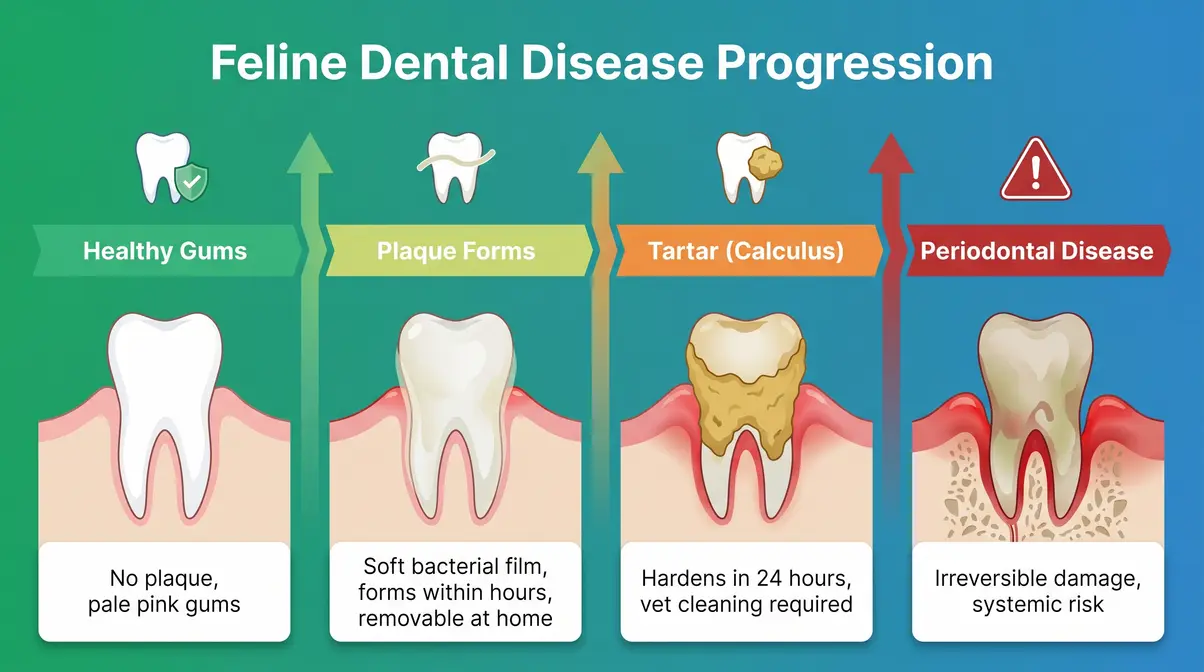
Dental plaque is a soft, sticky bacterial film that forms constantly on tooth surfaces. Bacteria in your cat’s mouth feed on food particles and produce acids that irritate the gum tissue. This film starts forming within hours of a meal – completely invisible at first, then gradually visible as a thin, slightly off-white coating near the gumline.
Here is the critical fact that motivates daily action: minerals in your cat’s saliva cause soft plaque to mineralise and harden into tartar in approximately 24 hours (University of Georgia College of Veterinary Medicine). Think of it like wet cement. When it is fresh, you can wipe it away with a cloth. Wait 24 hours, and you need a jackhammer. That is the difference between plaque and tartar – and it is why understanding cat plaque and tartar matters before you pick up a toothbrush.
At-home products – toothpaste, gels, water additives – can only work on soft plaque. Once plaque hardens, no home product can touch it. This is the core reason daily action matters.
Plaque hardens into tartar within 24 hours of forming – at which point it can only be removed safely by a veterinarian.
What causes tartar buildup on cats?
Tartar buildup in cats is caused by soft dental plaque that is not removed within 24 hours of forming. Tartar – also called dental calculus – is the rock-hard, mineralised form of plaque. It bonds directly to the tooth surface and cannot be brushed, wiped, or dissolved away at home. If plaque is wet cement, tartar is the dried concrete you find months later.
The health consequences escalate quickly. Tartar irritates the gum tissue and causes gingivitis (inflammation of the gums – you will notice redness and swelling along the gumline). Left untreated, gingivitis progresses to periodontal disease – a serious infection of the structures supporting the teeth, including the ligaments and jawbone. The Cornell Feline Health Center notes that regular tooth brushing using cat-formulated toothpaste is the most effective method to prevent this progression (2024). In severe cases, bacteria from periodontal disease enter the bloodstream and can damage the kidneys, liver, and heart.
According to data from DVM360, approximately 60% of cats aged 3 to 10 years show evidence of dental tartar – making this one of the most common health issues in domestic cats.
Here is a simple visual test: if your cat’s teeth look yellow-brown and feel rough when you gently touch them with a fingernail, that is tartar. If you see a thin, slightly off-white film near the gumline, that is soft plaque – and that is what you can tackle at home. The causes of feline bad breath and dental disease are almost always rooted in this plaque-to-tartar progression.
At-home methods remove soft plaque only. Tartar requires a professional veterinary cleaning. This sets up the entire framework for this guide – which we call The Tiered Dental Defense: a three-level approach matching your method to the severity of your cat’s dental situation. Level 1 uses passive VOHC-approved products for resistant cats. Level 2 is active brushing for willing cats. Level 3 is professional veterinary cleaning for hardened tartar. Now that you know what you are dealing with, here is everything you need to gather before your first attempt.
Step 2: Gather Your Supplies
Gathering the right tools before you start makes the entire process calmer – for you and your cat. The wrong products (particularly human toothpaste) can cause serious harm. Here is everything you need, explained simply, so you are ready before your cat is.
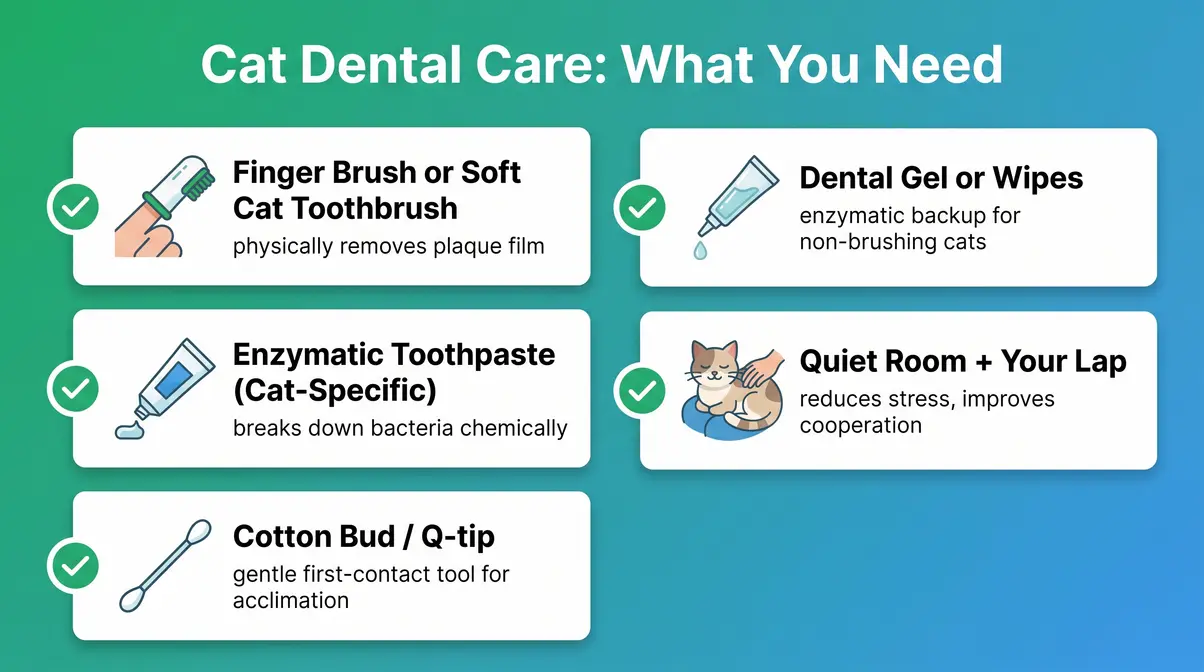
| Supply | What It Does | Where to Find It |
|---|---|---|
| Enzymatic toothpaste (cat-specific) | Breaks down plaque bacteria chemically | Pet stores, vet clinics |
| Finger brush or soft cat toothbrush | Physically removes plaque film from tooth surfaces | Pet stores |
| Cotton bud / Q-tip | Gentle first-contact tool during acclimation | Pharmacy, supermarket |
| Dental gel or wipes | Backup enzymatic option for non-brushing cats | Pet stores, online |
| Quiet room + your lap | Reduces stress so your cat stays still | Home |
The Cornell Feline Health Center states that removing plaque through regular tooth brushing with cat-specific enzymatic toothpaste is the most effective method to prevent feline dental disease. Enzymatic toothpaste works differently from regular toothpaste – the enzymes chemically disrupt the bacterial film even without vigorous scrubbing, which matters when your cat will only tolerate 30 seconds of brushing.
⚠️ Never use human toothpaste on cats. It contains fluoride and xylitol, both of which are toxic and can cause serious illness even in small amounts. Always check that the label explicitly states the product is safe for cats.
With your supplies ready, the real work begins – and the most important thing to know is that you should never jump straight to brushing.
Step 3: The Low-Stress Intro
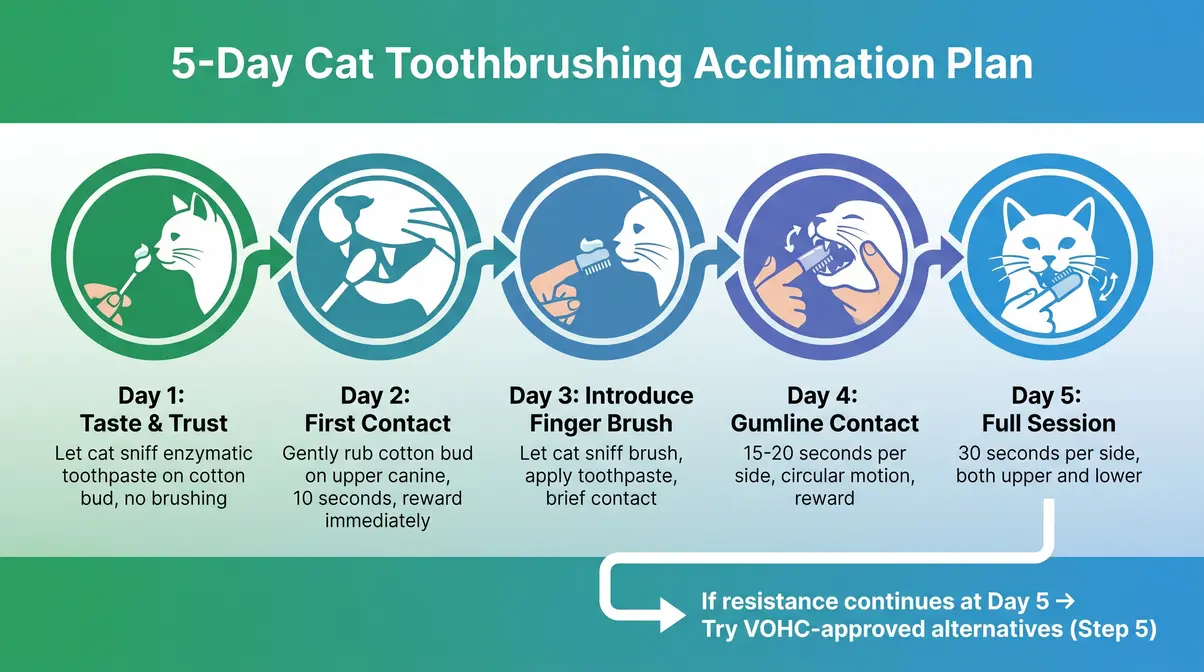
Rushing straight to brushing is the single most common mistake cat owners make – and it is the reason so many cats become resistant to dental care entirely. A 3-5 day gradual introduction dramatically increases your long-term success rate. Think of it as a small investment that pays off in years of cooperative dental sessions.
Cat owners across vet-moderated communities consistently report that cats who were introduced slowly to toothbrushing tolerated it far better than those whose owners skipped straight to the brush. The process is simple – and it costs you nothing but a few minutes per day.
Days 1-2: Touch, Taste, and Trust
Your goal for the first two days is not to clean anything. Your only goal is to make touching your cat’s mouth a positive, unremarkable experience.
- Choose a time when your cat is naturally calm – after a meal or a play session works well.
- Sit your cat in your lap with their back against your body. This position feels secure, not threatening.
- Dip a cotton bud in a small amount of enzymatic toothpaste and let your cat sniff and lick it. Most cats enjoy the poultry or malt flavour.
- Once your cat is comfortable with the taste, gently rub the cotton bud along the outer surface of the upper canine teeth (the long, pointed teeth at the front). Use small, circular motions. Ten seconds is enough.
- Immediately reward with a treat, praise, or playtime. End on a positive note every single time.
If your cat pulls away or swats, do not push through it. Stop, give a treat anyway, and try again tomorrow. Forcing the interaction at this stage creates lasting resistance. A calm enough cat is your most important asset here.
Days 3-5: Introduce the Brush
Once your cat accepts the cotton bud without fuss, it is time to transition to the finger brush.
- Apply a small pea-sized amount of enzymatic toothpaste to the finger brush.
- Let your cat sniff and lick the brush before you use it.
- Gently lift your cat’s upper lip with your thumb and place the finger brush on the outer surface of the upper back teeth (the molars).
- Use small circular motions along the gumline – the area where the tooth meets the gum. This is where plaque accumulates fastest.
- Brush for 15-20 seconds on each side, then stop and reward.
By Day 5, most cats will tolerate a 30-second session on each side. If your cat is still resistant at Day 5, that is completely normal – move to Step 5 for VOHC-approved alternatives before giving up on brushing entirely.
Step 4: Proper Brushing Technique
When learning how to remove plaque from cat teeth, daily brushing is the most effective method to prevent it from hardening into tartar. The VCA Animal Hospitals recommends brushing at least three times per week as the minimum to prevent tartar accumulation – but daily brushing is the gold standard. Here is exactly how to do it correctly.
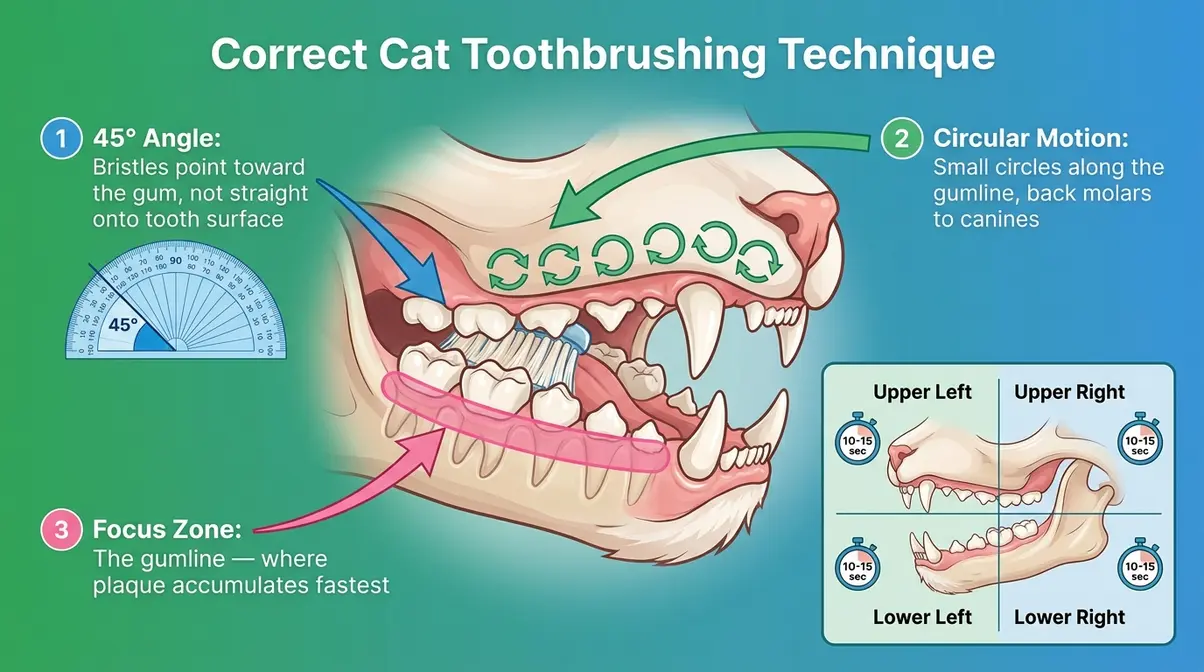
The Circular Brushing Technique
The most important thing to understand about brushing technique is this: you are not scrubbing the teeth clean. You are disrupting the soft bacterial film along the gumline, where plaque accumulates fastest and causes the most damage.
How to brush correctly:
- Position your cat in your lap, back against you, facing away. Place one hand gently over the top of their head, with your thumb and index finger resting lightly on their cheekbones.
- Apply a pea-sized amount of enzymatic toothpaste to the brush. Do not wet the brush – the toothpaste consistency helps it stay on the bristles.
- Lift the upper lip with your thumb to expose the outer surface of the teeth.
Once your cat is comfortably positioned, you can focus on the brushing motion itself:
- Place the brush at a 45-degree angle to the gumline – bristles pointing slightly upward toward the gum, not straight onto the tooth surface.
- Use small, gentle circular motions. Move from the back molars forward toward the canines. The circular motion dislodges plaque at the gumline far more effectively than back-and-forth scrubbing.
- Spend approximately 10-15 seconds on each quadrant (upper left, upper right, lower left, lower right).
- Focus on the outer surfaces – your cat’s tongue naturally cleans the inner surfaces.
Enzymatic toothpaste does the heavy lifting. Even if your cat only tolerates 30 seconds of brushing, the enzymes in the toothpaste continue working for several minutes after you stop. This is why cat-specific enzymatic toothpaste is non-negotiable – it is not just a carrier for the brush. Veterinary professionals consistently advise that the enzymatic action is what makes home dental care effective, not the mechanical force of brushing alone.
Reaching Back and Bottom Teeth
The back molars and premolars are where plaque build-up is most severe – and where most cat owners miss. These teeth do the heavy chewing work and accumulate the most food debris.
For back teeth (upper and lower molars):
Start at the back of the mouth and work forward. Gently hold the muzzle closed with one hand while using the other to lift the cheek flap. The cheek flap gives you access to the back teeth without forcing the mouth open wide, which cats resist strongly.
For bottom teeth:
Tilt your cat’s head very slightly upward. Use your thumb to gently lower the lower lip on one side at a time. Brush the outer surfaces of the lower teeth using the same 45-degree circular technique. The lower teeth are often overlooked – but they accumulate plaque just as quickly as the uppers.
For the area behind the canines:
The space just behind the upper canines (the long front teeth) is a common plaque trap. Use the tip of the finger brush in a small circular motion specifically in this area. Ten seconds is all it takes to clear this zone.
Learning how to remove plaque from back of teeth and behind teeth takes a little practice. After two or three sessions, your hands will find the right positions automatically. For a deeper dive into establishing this habit, review our comprehensive cat teeth cleaning guide. Owners of flat-faced breeds should also consult our breed-specific cat teeth care tips, as their jaw structure requires modified brushing angles.
If Your Cat Gets Upset Mid-Brush
Even a calm enough cat will have off days. Here is what to do when your cat starts to squirm, vocalise, or swat mid-session:
- Stop immediately. Do not try to finish the session through resistance – this creates lasting negative associations.
- Give a treat and praise anyway. You want the end of every session to feel positive, even a short one.
- Note what triggered the reaction. Was it a specific tooth area? Too much pressure? Brush it off and approach that area more gently next time.
- Shorten tomorrow’s session. If you managed 60 seconds today before resistance, aim for 45 seconds tomorrow and build back up gradually.
- Never punish or scold. Cats associate punishment with the person, not the behaviour – and you need your cat to trust you during dental sessions.
Common pain points reported by cat owners include resistance around the back molars, which are often inflamed or tender if periodontal disease has already begun. If your cat consistently reacts painfully to one specific area, stop brushing that area and consult your vet – this can be a sign of an underlying dental problem that needs professional attention.
Step 5: Vet-Approved Alternatives
Not every cat will tolerate brushing – and that is not a failure. The Tiered Dental Defense exists precisely for this situation. Level 1 of the framework covers passive, VOHC-approved products that reduce plaque build-up without requiring your cat to sit still for a toothbrush. The Veterinary Oral Health Council (VOHC) – a body that independently evaluates and certifies pet dental products – awards its Seal of Acceptance only to products that demonstrate measurable plaque or tartar reduction in controlled trials. If a product carries the VOHC seal, you can trust that it works. Always check the current VOHC accepted products list before purchasing, as the list is updated regularly.
Dental Wipes and Enzymatic Gels
If you are wondering how to remove plaque from cat teeth when your feline absolutely refuses a brush, dental wipes and gels are the closest alternative. They work on the same principle as enzymatic toothpaste – the enzymatic formula disrupts the bacterial film chemically – but they require no brush at all.
How to use dental wipes: Wrap the wipe around your index finger and rub it along the outer surface of the teeth in the same circular motion described in Step 4. Most cats find this less threatening than a brush because your finger is familiar.
How to use enzymatic gel: Apply a small amount directly to the gumline using your fingertip or a cotton bud. You do not need to rub it in vigorously – the enzymes do the work. Some gels can also be applied to the cat’s paw for them to lick off, which delivers enzymatic action to the teeth indirectly.
What is the best plaque remover for cats? Across veterinary professionals, the consistent advice is that VOHC-accepted enzymatic products – whether toothpaste, gels, or wipes – are the most evidence-backed options for at-home plaque removal. No single product is universally “the best,” but any product carrying the VOHC seal has passed independent efficacy testing.
Water Additives
Water additives are the most passive option available – you simply add a measured amount to your cat’s drinking water each day, and the antimicrobial formula works as your cat drinks normally. This makes them ideal for cats that resist all forms of direct mouth contact.
Healthymouth® Water Additive for Cats is one of the few water additives to carry the VOHC Seal of Acceptance for plaque control in cats (as of the March 2026 VOHC accepted products list). Look specifically for the VOHC seal on any water additive you consider – many products on the market make dental claims without independent verification.
Important caveats: Water additives work best as a supplement to other dental care, not as a standalone solution. Some cats dislike the taste and may drink less water as a result. Always introduce water additives gradually – start with a quarter of the recommended dose and increase over one week. Monitor your cat’s water intake carefully during the introduction period.
VOHC-Approved Dental Treats
Dental treats are one of the most practical alternatives for owners of cats that refuse any form of mouth contact. Chewing action mechanically disrupts soft plaque, while enzymatic formulas in the treat itself add chemical disruption.
VOHC-accepted dental treats for cats currently include Feline Greenies® Dental Treats, Whiskas® Dentabites, Purina DentaLife Daily Oral Care Cat Treats, and Purina Pro Plan Veterinary Diet Dental Bites (as of the VOHC accepted products list, March 2026). Always verify the VOHC seal on the packaging – not all dental treats are created equal, and many popular brands have not undergone independent efficacy testing.
How to use them effectively: Give dental treats after meals, not as a between-meal snack. Post-meal timing means fresh food debris is still present, and the mechanical and enzymatic action of chewing is most effective against fresh plaque. One serving per day is typically the recommended dose – check the product packaging for your cat’s weight-appropriate serving size.
Confusion about whether dental treats actually work is one of the most common pain points reported by cat owners. The answer is clear: VOHC-accepted treats have demonstrated measurable plaque or tartar reduction in controlled trials. Non-VOHC treats may or may not help – the seal is your evidence filter.
Prescription Dental Diets
Prescription dental diets represent the most comprehensive passive approach in The Tiered Dental Defense. These diets are formulated with a specific kibble texture and size that creates a mechanical scrubbing action as the cat chews – the kibble does not crumble on contact but instead slides down the tooth, wiping the surface clean.
VOHC-accepted dental diets for cats include Hill’s Prescription Diet Feline t/d® (veterinary prescription required), Science Diet® Oral Care for Cats (available at pet stores), Royal Canin Feline Dental Diet, Healthy Advantage™ Oral+ for Cats, and Purina Pro Plan Veterinary Diets DH Feline Formula (veterinary prescription required). Research from the University of California, Davis School of Veterinary Medicine supports the efficacy of prescription dental diets in reducing plaque and calculus accumulation in cats.
Important: If your cat is on a prescription diet for another condition (kidney disease, urinary health, weight management), do not switch to a dental diet without consulting your vet first. Nutritional needs can conflict, and your vet can advise on the safest combination. If you are considering a dietary switch, reading Science Diet oral care adult dry cat food reviews can help you understand how kibble size affects plaque removal. For a broader look at feline nutrition, explore our guide on understanding my cat’s diet.
Step 6: When Vet Care Is Required
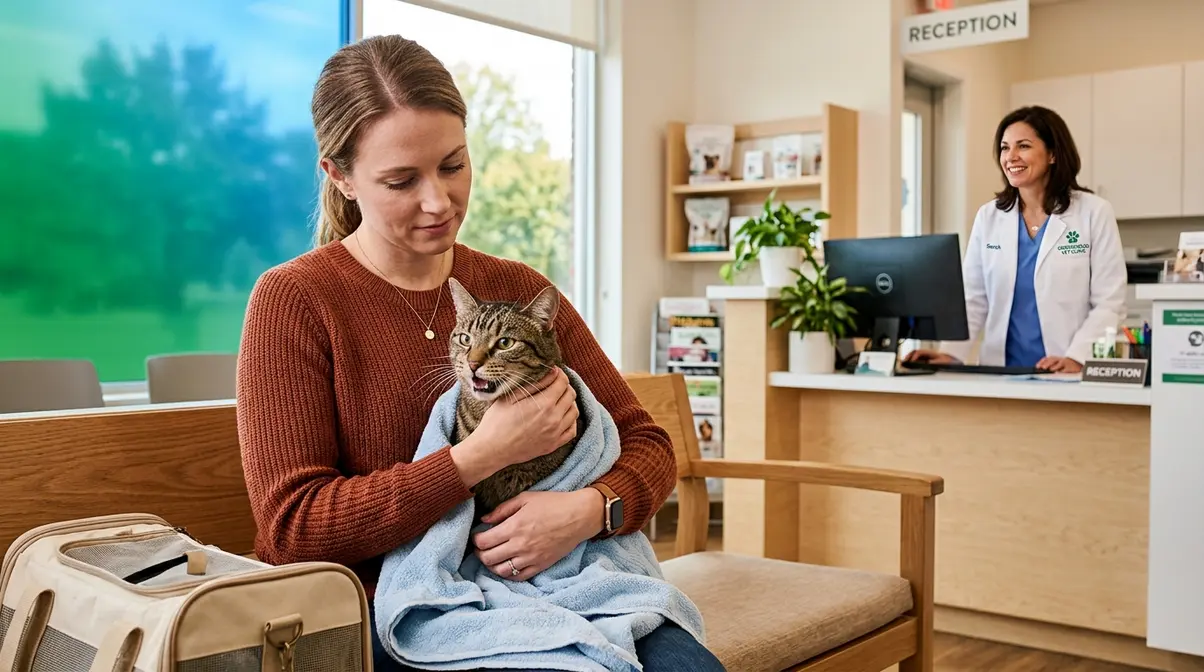
There is a firm line in feline dental care between what you can safely do at home and what requires a veterinarian. Crossing that line – particularly by attempting to scrape tartar off at home – can cause serious harm. This step draws that line clearly.
Can I scrape tartar off at home?
No – scraping tartar off your cat’s teeth at home is dangerous and should never be attempted. This is one of the most important warnings in this guide. You may have seen videos online showing people using metal tools to scrape tartar off their cat’s teeth at home. Do not do this. Veterinary sources – including multiple vet dental specialists – unanimously advise against at-home tartar removal using tools or sharp objects.
Here is why it is dangerous:
- Tartar is rock-hard. Scraping it with a tool requires significant force. That force can chip or fracture the tooth enamel, causing irreversible damage that is far more expensive to treat than a professional cleaning.
- The gumline is fragile. Slipping while scraping can lacerate the gum tissue, creating open wounds that become infected.
- Subgingival tartar is invisible. The tartar you can see is only part of the problem. Tartar below the gumline – where the most serious infection occurs – cannot be reached safely without specialised instruments and anaesthesia.
- Stress causes pain. A cat being scraped without anaesthesia will move. Movement during scraping dramatically increases the risk of injury to both the cat and the owner.
- Cosmetic scraping is not cleaning. Even if you remove visible tartar from the tooth surface, bacteria in the tartar below the gumline remain untouched. The tooth may look cleaner, but the infection continues.
The American Veterinary Dental College (AVDC) is explicit: professional dental cleaning requires general anaesthesia to be performed safely and effectively. This is not a cost-cutting measure by vets – it is a medical necessity that allows the vet to clean below the gumline, probe for pockets of infection, and take dental X-rays that reveal problems invisible to the naked eye.
Can vinegar remove hardened tartar?
No – vinegar cannot safely or effectively remove tartar from cat teeth. Another common DIY recommendation circulating online is using diluted vinegar to dissolve tartar on cats’ teeth. This is not only ineffective – it is potentially harmful.
Tartar (dental calculus) is mineralised and bonded to the tooth surface. Vinegar is a weak acid. While acid can theoretically dissolve mineral deposits over time, the concentration needed to dissolve tartar would damage tooth enamel long before it made any meaningful impact on the calculus. In practice, household vinegar concentrations do nothing to tartar.
Beyond ineffectiveness, vinegar is aversive to most cats – the strong smell alone causes distress. Repeated exposure to acidic solutions in the mouth can irritate the sensitive mucous membranes of the gums and cheeks. There is no veterinary evidence supporting vinegar as a dental treatment for cats, and no credible veterinary source recommends it.
What dissolves hardened plaque?
Nothing available at home dissolves hardened tartar on cats’ teeth. Tartar is mineralised plaque that has bonded to the tooth surface – it requires professional ultrasonic scaling equipment, used by a veterinarian under general anaesthesia, to remove safely. At-home products including enzymatic toothpaste, water additives, and dental gels can only prevent soft plaque from hardening into tartar in the first place. Once tartar has formed, the only safe solution is a professional veterinary dental cleaning.
5 Signs Your Cat Needs a Vet Now
If you notice any of the following, do not delay – book a veterinary appointment today. These signs indicate that dental disease has progressed beyond what home care can address:
- Persistent bad breath – a strong, foul odour from the mouth that does not improve is a hallmark sign of bacterial infection and periodontal disease.
- Red, swollen, or bleeding gums – healthy gums are pale pink. Redness along the gumline indicates active gingivitis. Bleeding when touched is a sign of significant inflammation.
- Visible brown or yellow buildup – thick, brown-coloured deposits on the teeth, particularly near the gumline, indicate established tartar that brushing cannot remove.
Additionally, watch for behavioral changes that indicate severe oral discomfort:
- Drooling more than usual – excessive drooling, especially if tinged with blood, signals oral pain or infection.
- Difficulty eating, dropping food, or avoiding hard food – a cat with dental pain will change their eating behaviour. Favouring one side of the mouth, dropping food mid-chew, or refusing kibble are all warning signs.
Veterinary professionals advise that cats showing two or more of these signs simultaneously should be seen by a vet within 48 hours, not at the next routine check-up. The cost of a professional cleaning is significantly less than treating the systemic complications of advanced periodontal disease.
Step 7: Build a Lasting Routine
After two to four weeks of consistent daily brushing (or VOHC-approved alternative use), you should begin to see measurable improvement. Here is what success looks like and how to sustain it:
- Signs that your home dental care is working:
- The thin off-white film near the gumline is visibly reduced or absent after brushing
- Your cat’s breath is noticeably fresher
- The gums appear pale pink rather than red or inflamed
- Your cat is tolerating dental sessions with less resistance
Building a sustainable routine:
Brush at the same time each day – most cats adapt to predictable routines quickly. After a meal is ideal. Keep sessions short (60-90 seconds total) and always end with a reward. Consistency beats duration: three minutes of daily brushing will outperform a weekly 10-minute session every time.
- Ongoing schedule:
- Daily: Brush or use a dental gel/wipe
- Daily: Dental treats after meals (if using as a supplement)
- Every 6-12 months: Professional veterinary dental check-up, even if home care is going well
If you are not seeing improvement in your cat’s gum redness or breath after four weeks of consistent home care, consult your vet. Some cats have underlying dental disease that requires professional intervention before home care becomes effective.
Troubleshooting Common Problems
“My cat won’t open their mouth at all.”
Do not force it. Start with water additives and dental treats (Step 5) for two to three weeks, then retry the acclimation protocol from Step 3. The goal is to make mouth-touching a neutral experience before introducing any tool.
“My cat bites when I try to brush.”
Biting during brushing usually means you have moved too fast through the acclimation phase, or the cat is experiencing oral pain. Return to the cotton bud stage for another week. If biting continues despite slow re-introduction, have your vet check for underlying dental pain before continuing.
“The toothpaste keeps falling off the brush.”
Use a very small amount – a pea-sized blob is correct. Do not wet the brush before applying toothpaste. If using a finger brush, press the toothpaste into the bristles with your thumb before positioning.
“My cat seemed fine at first but now resists again.”
Regression is normal, especially after any stressful event (a vet visit, a new pet, a move). Return to the Day 1-2 protocol for three days, then rebuild. Consistency is the goal – not perfection.
“I can see brown buildup that brushing is not removing.”
If the buildup is brown, rough, and does not come off after consistent brushing, it is tartar – not soft plaque. Home care cannot remove it. Book a professional dental cleaning with your vet. This is the firm boundary of Level 3 in The Tiered Dental Defense.
“My cat only eats wet food – does that make dental care harder?”
Yes, slightly. Dry kibble provides some mechanical cleaning action; wet food does not. Cats on wet food diets benefit most from daily brushing or VOHC-accepted dental treats designed to provide the mechanical action that wet food lacks.
Frequently Asked Questions
What is the best plaque remover?
Daily brushing with cat-specific enzymatic toothpaste is the most effective plaque remover for cats, according to the Cornell Feline Health Center (2024). The enzymatic formula disrupts bacterial plaque chemically, even when brushing time is limited. For cats that refuse brushing, VOHC-accepted alternatives – including Feline Greenies® Dental Treats, Healthymouth® Water Additive, and enzymatic dental gels – have demonstrated measurable plaque reduction in independent trials. Always look for the VOHC Seal of Acceptance when choosing any dental product for your cat.
How to get rid of plaque build-up?
To remove soft plaque build-up from your cat’s teeth, brush daily using enzymatic toothpaste and a finger brush or soft cat toothbrush, following the circular-motion technique along the gumline described in Step 4 of this guide. For cats that resist brushing, VOHC-approved dental treats, water additives, and enzymatic gels are effective alternatives. Plaque that has already hardened into tartar cannot be removed at home – it requires a professional veterinary cleaning. Starting home care early, before tartar forms, is the most cost-effective approach.
What dissolves plaque naturally?
Enzymatic action is the most natural and effective way to disrupt soft plaque in cats. Enzymatic toothpastes and gels contain enzymes – such as glucose oxidase and lactoperoxidase – that occur naturally in saliva and work by breaking down the bacterial film chemically. VOHC-accepted dental treats provide mechanical disruption through chewing, which mimics the natural cleaning action of prey consumption. No true home “natural remedy” (including coconut oil, baking soda, or vinegar) has demonstrated efficacy in independent veterinary trials for cats.
What is the 3-3-3 rule for cats?
The 3-3-3 rule for cats describes the typical adjustment timeline when a cat moves to a new home: 3 days to decompress and feel safe, 3 weeks to learn the household routine, and 3 months to fully settle and show their true personality. While this rule is not directly related to dental care, it is relevant to timing: do not start a new dental care routine during the first 3 days in a new home. Wait until your cat has decompressed before introducing toothbrushing or any new handling. Stress during the adjustment period increases resistance to new experiences.
How often should I brush my cat’s teeth?
Daily brushing is the gold standard for cat dental care, according to the VCA Animal Hospitals (2026). Brushing at least three times per week is the minimum recommended frequency to prevent tartar accumulation. Brushing every other day can also make a meaningful difference. The key is consistency – short daily sessions of 60-90 seconds are more effective than infrequent longer sessions. Even if your cat only tolerates 30 seconds per day, the enzymatic action of cat-specific toothpaste continues working for several minutes after brushing stops, extending the benefit.
When Home Care Isn’t Enough
Common Pitfalls to Avoid
Starting with the toothbrush on Day 1. The single most common mistake – and the one most likely to create a permanently resistant cat. Always spend at least two days on the cotton bud acclimation phase before introducing any brush.
Using human toothpaste “just this once.” There is no safe dose. Fluoride and xylitol are toxic to cats in any quantity. A single accidental ingestion of human toothpaste can cause hypoglycaemia (dangerously low blood sugar) from the xylitol alone. Keep human toothpaste completely out of reach.
Assuming visible improvement means the problem is solved. Fresher breath and pinker gums are positive signs – but they do not mean existing tartar has disappeared. Home care prevents new tartar; it does not remove existing deposits. Annual veterinary dental check-ups remain essential even for cats with excellent home dental routines.
Choosing dental products without the VOHC seal. Many products marketed as “dental” for cats have not undergone independent efficacy testing. The VOHC seal is your evidence filter – if it is not there, you cannot be certain the product works.
When to Choose Alternatives
If your cat has visible brown tartar: Skip home brushing as the primary solution and book a professional dental cleaning first. Once the tartar is removed professionally, home care prevents re-accumulation.
If your cat shows any of the 5 warning signs from Step 6: Professional care is non-negotiable. Home care is not a substitute – it is a complement to, not a replacement for, veterinary dental treatment.
If home care is not improving gum redness after 4 weeks: This is a sign of established gingivitis or periodontal disease that requires professional intervention. A vet can assess the extent of the disease and recommend the appropriate treatment plan.
When to Seek Expert Help
If your cat’s breath is extremely foul, if they are in visible pain when eating, or if you notice loose or missing teeth, these are emergency-level dental signs. Do not delay seeking veterinary care for these symptoms – they indicate active infection that can spread systemically. Similarly, if your cat has not had a professional dental examination in over 12 months and is over the age of 3 (when dental disease prevalence rises sharply), scheduling a dental check-up is strongly recommended even in the absence of obvious symptoms.
Building a Dental Routine That Actually Lasts
For concerned, cost-conscious cat owners, knowing how to remove plaque from cat teeth at home is genuinely empowering – and the evidence is clear that it works. Approximately 60% of cats aged 3 to 10 years show evidence of dental tartar (DVM360, citing veterinary research), but consistent daily brushing with enzymatic toothpaste can prevent most of that accumulation from ever forming. The earlier you start, the less tartar there is to manage professionally – and the lower the long-term cost of your cat’s dental health.
The Tiered Dental Defense gives you a clear decision framework: start with VOHC-approved passive products if your cat resists all contact, move to active brushing once your cat is acclimated, and escalate to professional veterinary cleaning the moment you see warning signs that home care cannot address. Each level is a genuine option – not a compromise.
Your next step is simple: gather your supplies tonight, spend two days on the cotton bud acclimation phase, and introduce the finger brush by Day 3. Most cats show measurable improvement in gum colour and breath freshness within two to four weeks of consistent daily care. If you are unsure where to begin, your vet can demonstrate the brushing technique at your cat’s next check-up – a 10-minute demonstration is worth months of guesswork.